
Dental
Understanding Your Options for Replacing Multiple Missing Teeth

Table of Contents
- Dental Implants
- Implant-Supported Bridges
- Traditional Dental Bridges
- Removable Partial Dentures
- Full Arch Implant Restorations
- Implant-Supported Dentures
- Factors to Consider When Choosing a Replacement Option
- Conclusion
Experiencing the loss of several teeth can deeply affect day-to-day life, from changing how you chew your favorite foods to impacting your self-confidence when smiling. Thankfully, advancements in dental care offer modern solutions that not only restore the look and function of your teeth but also help you regain confidence. One effective approach to rebuilding a strong, beautiful smile is full mouth restoration, a comprehensive option often recommended by dental professionals.
Exploring your teeth replacement solutions starts with understanding what each treatment offers and which option aligns with your health goals and lifestyle preferences. These dental advancements ensure that everyone, regardless of the extent of tooth loss, has access to methods that restore both oral function and aesthetics.
With multiple methods available, knowing the pros and cons can help set realistic expectations and guide your choices. Factors such as long-term durability, appearance, ease of maintenance, and budget all play critical roles when selecting the most appropriate treatment.
Selecting the right solution with a dental expert’s guidance can have a lasting impact on your oral health and appearance. The following guide outlines the most effective methods for replacing multiple missing teeth so you can make an informed decision about your future smile.
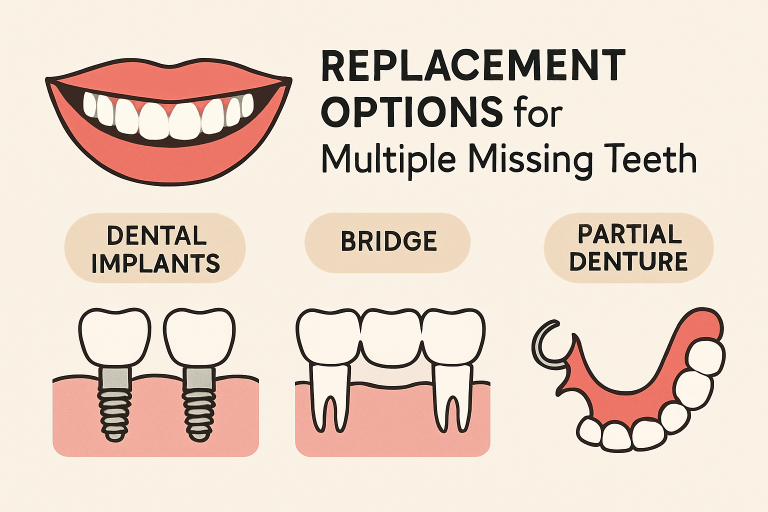
Dental Implants
Dental implants are one of the most reliable options for replacing missing teeth. The procedure involves surgically placing titanium posts into the jawbone, which act as artificial tooth roots. Over time, the bone fuses with these posts, creating a stable foundation for attaching crowns or bridges. Implants help maintain jawbone density and prevent bone loss, provide a natural look and feel, and allow adjacent healthy teeth to remain untouched. However, they require sufficient healthy bone for successful placement, involve a multi-step process with a healing period, and generally entail a higher initial cost than other tooth replacement options.
Implant-Supported Bridges
Implant-supported bridges offer an effective solution for replacing several consecutive missing teeth using only a few implant posts. A series of connected crowns spans the gap, providing a functional and aesthetically pleasing restoration. This approach is more cost-efficient than placing a separate implant for each missing tooth, helps preserve bone density with fewer implants, and distributes bite forces evenly for a secure and stable result. However, sufficient bone structure is necessary to support the implants, and patients must allow time for the healing process before the final bridge can be placed.
Traditional Dental Bridges
Traditional dental bridges are a well-established solution for replacing missing teeth, using artificial teeth anchored to crowns placed on neighboring natural teeth. This approach effectively restores chewing and speaking abilities while providing a natural-looking result. Compared to implants, dental bridges can often be completed more quickly. However, they require removing enamel from healthy adjacent teeth to accommodate the crowns, and they do not prevent jawbone loss in the area of the missing teeth.
Removable Partial Dentures
Removable partial dentures offer an affordable and flexible option for individuals who still have some natural teeth. These dentures consist of artificial teeth set in a gum-colored base and supported by a metal framework, making tooth restoration accessible and straightforward. They are generally less costly than many fixed restorations, do not require invasive surgery, and are relatively easy to repair or replace as needed. However, removable partial dentures are less secure than fixed prosthetics and may shift slightly while speaking or chewing. Periodic adjustments are often necessary, and some users may experience minor discomfort from time to time.
Full Arch Implant Restorations
Full arch implant restorations provide a comprehensive solution for patients who require the complete replacement of all teeth in a single jaw. Techniques such as All-on-4 use four or more strategically placed implants to securely support an entire arch of prosthetic teeth, offering both functional strength and a significant improvement in appearance. These restorations deliver robust chewing power and a natural feel, help preserve jawbone structure, and are permanently fixed, eliminating the need for daily removal for cleaning. On the other hand, they involve higher upfront costs due to the procedure’s complexity, require sufficient bone tissue to anchor the implants, and necessitate a longer treatment timeline to allow for proper healing.
Implant-Supported Dentures
Implant-supported dentures, also known as overdentures, offer a balanced solution that combines the affordability of traditional dentures with the added stability provided by dental implants. These dentures are designed to snap onto the implants, enhancing retention and comfort while offering an option for individuals who may not want a fully fixed solution. Compared to standard dentures, implant-supported dentures provide greater stability and comfort, are generally more affordable than full-arch fixed implant restorations, and are easy to remove and maintain. However, they do not provide the complete stability of non-removable options, require regular maintenance and occasional adjustments, and still depend on sufficient bone structure to support the implants.
Factors to Consider When Choosing a Replacement Option
The decision to replace multiple missing teeth should consider personal oral health status, jawbone structure, desired results, and financial planning. Consulting with a dental professional is vital to assess underlying conditions such as gum health and remaining tooth structure.
- Oral Health: The health of your gums and adjacent teeth may affect your candidacy for certain therapies.
- Bone Density: Most implant-based procedures require sufficient bone for placement and stability.
- Budget: Ranges from economical solutions like removable dentures to more complex and permanent restorations such as implants.
- Lifestyle Preferences: Consider whether you are comfortable with surgical procedures or prefer a removable option.
For more insight into the dental restoration process, visit the WebMD dental implant resource.
Conclusion
Prioritizing the replacement of multiple missing teeth supports oral health, restores function, and enhances self-confidence. The array of modern options means there is a solution suitable for everyone, from conservative to comprehensive. Exploring each possibility with your dental team ensures you select the replacement that matches your needs and fits your lifestyle, helping you reclaim your smile and quality of life.

Building A Better Commercial Painting Plan From Prep To Completion

What Makes Legal Marketing Different From Marketing Almost Anything Else?

Why Bar Stools Can Completely Change the Feel of a Kitchen
Ways Proper Garage Door Installation Improves Performance

How to Compare Maine Neighborhoods Before Buying a Home in 2026

The Future of Home EV Charging: Trends, Benefits, and What Drivers Need to Know

How Septic Tank Pumping Services in Huntsville AL Protect Soil Absorption Systems

Foundation Crack Repair Using Injection Methods

How do you know when you need to change your primary care doctor
The Importance of Accurate Inventories Before Moving Day
Ways Proper Garage Door Installation Improves Performance
What Makes Legal Marketing Different From Marketing Almost Anything Else?
Why Bar Stools Can Completely Change the Feel of a Kitchen