
Business
Types of Industrial Wear Parts and Their Lifecycles

Key Takeaways
- Wear parts are crucial for machinery reliability and efficiency.
- Material choice, maintenance, and operating conditions affect lifespan.
- Predictive maintenance and digital monitoring prevent failures and optimize costs.
- Advances in durable materials improve performance and reduce downtime.
- Sustainable practices and trusted suppliers support long-term reliability and environmental goals.
Industrial machinery is at the heart of global manufacturing and resource extraction, and its reliability fundamentally depends on the quality and durability of its wear parts. These components are engineered to withstand ongoing challenges such as friction, impact, and material erosion, thereby enhancing operational efficiency. Companies such as Cruco Mill & Industrial Supply specialize in supplying robust wear parts designed to extend machinery lifespan and minimize costly downtime.
From mining operations to precision manufacturing, industries across the board rely on machinery equipped with purpose-built wear parts. Choosing the right wear part and understanding its lifecycle can determine whether operations run smoothly or come to a halt due to unexpected failure. To optimize asset performance and sustainably manage costs, it is crucial to understand the types, materials, and projected lifespans of these industrial components.
Common Types of Industrial Wear Parts
Wear parts are customized by industry and application, serving crucial functions that protect machines and ensure consistent output. Notable examples include:
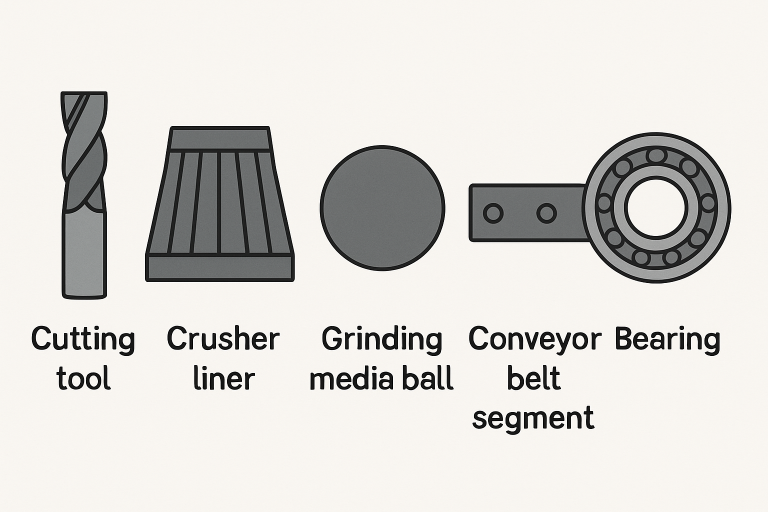
- Cutting Tools: Critical in processes such as machining and drilling, these tools, often manufactured from high-speed steel or durable carbide, are engineered to withstand high temperatures and intense mechanical pressure.
- Crusher Liners: Vital for the mining and aggregate sectors, crusher liners form a protective layer in crushing equipment, defending against abrasive materials such as ore and stone.
- Grinding Media: Used within mills, these components, typically balls or rods composed of steel or ceramics, facilitate the grinding and pulverizing of materials, a core function in mineral processing and cement production.
- Conveyor Belts: Found in virtually any bulk material handling application, these belts are commonly made from layers of tough rubber or synthetic textiles, offering flexibility and durability.
- Bearings: Essential for reducing friction between moving parts, bearings are generally crafted from hardened steel or advanced ceramics to promote smooth, efficient operation.
Factors Influencing Wear Part Lifecycles
The wear resistance and overall life expectancy of industrial wear parts are determined by several significant factors:
- Material Composition: The integration of alloys and composite materials can significantly enhance the durability of wear parts. For example, high-chromium white iron is frequently used in mining for its superior abrasion resistance properties.
- Operational Conditions: Variables such as mechanical load, operating speed, and the presence of harsh environmental conditions (including corrosive chemicals and abrasive dust) accelerate component wear.
- Maintenance Practices: Consistent maintenance schedules, frequent inspections, and the use of high-quality lubricants are instrumental in prolonging part service life and preempting failures.
According to experts at MIT, proactive maintenance not only extends component life but also prevents unexpected failures, supporting sustainable industrial operations.
Advancements in Wear-Resistant Materials
Innovation in materials science is driving substantial improvements in wear-part durability and operational efficiency. Recent developments include:
- High-Chromium Cast Iron: Achieving hardness ratings up to 62 HRC through strict metallurgical controls, this material offers exceptional wear resistance and outperforms conventional steel alloys in harsh environments.
- Nickel-Hard Alloys: These alloys merge impressive hardness with increased impact resistance, making them a preferred option for quarry and mining industry crusher parts.
- Tungsten Carbide Composites: Their unmatched hardness makes them indispensable for parts exposed to extreme abrasion, such as drill bits and certain types of hydraulic pump components.
Material research is ongoing to find eco-friendly solutions that combine wear resistance with recyclability, aligning performance with sustainability targets.
Predictive Maintenance and Lifecycle Management
The adoption of predictive maintenance strategies is revolutionizing wear parts management. Leveraging real-time sensor data and artificial intelligence, automated systems can accurately forecast component fatigue and impending failures. This data-driven approach not only prevents unplanned stoppages but enables facilities to order and replace parts just in time, optimizing inventory and labor efficiency.
Lifecycle management programs now use digital tools and platforms to monitor performance trends, set benchmarks for replacement intervals, and rapidly identify parts that require attention. These advances help align operational goals with total cost of ownership and asset reliability.
Environmental Considerations and Sustainability
There is growing momentum in the industrial sector to align equipment operation and replacement practices with the principles of environmental stewardship. Key measures include designing wear parts for multiple life cycles, establishing component take-back schemes, and incorporating recycled materials into new part production.
Industries are increasingly favoring suppliers that actively promote sustainability by minimizing waste, enhancing recyclability, and supporting closed-loop supply chains. This approach not only protects the environment but can also improve a company’s compliance and brand reputation.
Final Thoughts
The landscape of industrial wear parts is evolving rapidly. Understanding the various types of wear parts, the factors that influence their lifecycles, and the advancements in material technologies is crucial for facility managers and maintenance teams aiming to optimize performance and manage costs. By prioritizing predictive maintenance, selecting durable components, and integrating sustainability practices, today’s industries can ensure machinery reliability and reduce their ecological footprint.

Building A Better Commercial Painting Plan From Prep To Completion

What Makes Legal Marketing Different From Marketing Almost Anything Else?

Why Bar Stools Can Completely Change the Feel of a Kitchen
Ways Proper Garage Door Installation Improves Performance

How to Compare Maine Neighborhoods Before Buying a Home in 2026

The Future of Home EV Charging: Trends, Benefits, and What Drivers Need to Know

How Septic Tank Pumping Services in Huntsville AL Protect Soil Absorption Systems

Foundation Crack Repair Using Injection Methods

How do you know when you need to change your primary care doctor
The Importance of Accurate Inventories Before Moving Day
Ways Proper Garage Door Installation Improves Performance
What Makes Legal Marketing Different From Marketing Almost Anything Else?
Why Bar Stools Can Completely Change the Feel of a Kitchen