
Business
Transforming Enterprise E-Commerce: How React Native Apps Enable Real-Time Inventory Management at Scale

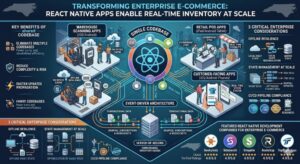
Enterprise e-commerce teams managing multi-billion-dollar product portfolios often face a critical problem: the systems beneath them cannot process transactions and inventory updates at the speed the business demands. Inventory refreshing every 15 minutes may have worked years ago. Today, with omnichannel fulfillment, third-party logistics integrations, and customers expecting real-time stock visibility, that lag drives overselling, stockouts, and write-off cycles that erode margins.
The challenge is not awareness. Most VPs of Engineering and Digital Platform leads recognize that the gap exists. The real challenge lies in designing an architecture capable of handling hundreds of thousands of SKUs in real time, flexible enough to span warehouses, retail, and mobile touchpoints, and maintainable by already stretched teams. React Native allows teams to close this gap without expanding headcount unnecessarily.
When Inventory Lag Becomes A Revenue Problem
Traditional e-commerce stacks carry a structural weakness. An order placed on a mobile app triggers a warehouse deduction, which may not immediately synchronize with the retail POS system. Updates are then fed back into the customer-facing catalog after a delay. Each handoff introduces latency. At scale, latency translates into revenue loss.
Research from the IHL Group estimates retailers lose approximately $1.75 trillion annually from overstock and out-of-stock events combined. Enterprises operating across multiple fulfillment centers and sales channels experience these losses as poor customer experience, higher returns, and persistent gaps between digital demand signals and physical fulfillment capacity.
Every delay in inventory data visibility compounds across channels. A warehouse stockout may not register on the storefront, causing overselling and fulfillment conflicts. Conversely, outdated catalog data may leave products unavailable even when stock exists. For executives overseeing multi-billion-dollar product lines, these issues have direct implications on revenue, customer satisfaction, and operational efficiency.
The Architectural Case For React Native
React Native changes the architecture conversation for enterprise teams. By allowing ecommerce app development teams to build once and deploy across all touchpoints, including iOS warehouse scanning, Android store apps, and customer-facing storefronts, it eliminates multiple codebases that increase complexity and risk.
A shared codebase consuming the same API layer ensures inventory state changes propagate consistently, reducing the gap between what customers see and what warehouses hold. React Native supports event-driven architectures with real-time WebSocket connections, offline-first warehouse capabilities, and native-performance UI. GraphQL subscriptions or WebSocket endpoints push inventory updates directly to all clients. Both iOS and Android apps remain aligned with the server-of-record.
Investments from Meta and Microsoft, including Fabric’s concurrent rendering architecture, make React Native suitable for enterprise workloads. For engineering leaders evaluating mobile platforms, these developments demonstrate that React Native can meet enterprise requirements for performance, scalability, and maintainability without creating silos across channels.
Three Problems Teams Discover Too Late
Deploying React Native at enterprise scale exposes three consistent challenges:
Offline Resilience
Warehouse environments often contain connectivity dead zones. Apps that stop working when coverage drops halt operations. Conflict-resolution logic must reconcile local writes against the server-of-record state. Treating offline capability as a secondary feature leads to extensive post-go-live fixes and operational delays. Teams must plan an offline-first architecture from day one to maintain real-time accuracy without manual intervention.
State Management At Scale
Managing tens of thousands of SKUs across multiple warehouses requires client-side layers optimized for high-frequency partial updates. Redux patterns from consumer apps often fail under this load. Tools such as React Query or Zustand with custom selectors provide normalized, high-performance caching and prevent unnecessary full-tree re-renders. Enterprise teams must adopt scalable state management strategies to ensure responsiveness during peak transaction periods.
CI/CD Pipeline Compliance
Enterprise deployments must meet SOC 2 or ISO 27001 controls and integrate with existing DevSecOps pipelines. Teams unfamiliar with enterprise-grade React Native pipelines often face weeks of remediation after build architecture decisions. Establishing compliance and security checks from the outset avoids delays, ensures audit readiness, and supports continuous delivery without operational disruption.
These challenges are solvable but require teams that anticipate them before entering development. Planning for these considerations prevents months of rework and allows mobile initiatives to deliver business value rapidly.
5 Established React Native Development Companies For Enterprise E-Commerce
Enterprise teams seeking external partners to accelerate React Native initiatives can evaluate firms with verified performance records. Rankings reflect Clutch-verified ratings and total reviews.
1. GeekyAnts
GeekyAnts specializes in digital transformation, end-to-end app development, digital product design, and custom software solutions. Founded in 2006, the firm has delivered over 800 projects for enterprise clients, including Google, WeWork, ABB, and ICICI Securities. GeekyAnts created NativeBase and gluestack-ui, widely adopted React Native UI libraries. The firm combines global engineering capacity with deep expertise in enterprise-grade mobile and web applications, making it a preferred choice for large-scale deployments. Clutch Rating: 4.9 / 5.0 111 Verified Reviews. Address: 315 Montgomery Street, 9th & 10th Floors, San Francisco, CA 94104, Phone: +1 (415) 275-9099, Email: [email protected], Website: www.geekyants.com
2. Sidebench
Sidebench provides strategy, design, and development consultancy from Los Angeles. The firm focuses on complex enterprise system integration and high-stakes mobile product builds. Sidebench has earned multiple Clutch Global Leaders Awards for Mobile App Development and delivers full-cycle React Native applications for enterprise clients, ensuring reliability and scalability. Clutch Rating: 4.9 / 5.0 · 48 Verified Reviews. Address: 149 South Barrington Avenue, Suite 508, Los Angeles, CA 90049, Phone: +1 (310) 893-3589
3. Simpalm
Simpalm develops digital products from offices in Rockville, MD, and Chicago, IL. The firm delivers enterprise mobile and web solutions across healthcare, fintech, retail, and logistics sectors. Simpalm maintains a 97% on-time delivery rate and applies structured sprint management and clear communication. The company builds cross-platform apps using React Native and native stacks, ensuring high performance and reliability in enterprise deployments. Clutch Rating: 4.8 / 5.0 · 58 Verified Reviews Address: 11821 Parklawn Drive, Suite 130, Rockville, MD 20852, Phone: +1 (301) 825-5351
4. Rootstrap
Rootstrap is a nearshore software agency headquartered in West Hollywood, CA. It provides full-cycle product development and embedded staff augmentation for Fortune 500 and high-growth enterprise clients. Notable engagements include MasterClass, Google, and Globalization Partners. Rootstrap uses a squad-based model to scale development capacity efficiently without increasing traditional hiring overhead. Clutch Rating: 4.8 / 5.0 · 44 Verified Reviews. Address: 8913 W Sunset Blvd, Suite 1/2, West Hollywood, CA 90069, Phone: +1 (310) 907-9210
5. Topflight Apps
Topflight Apps builds mobile and web applications from Irvine, CA. The firm serves enterprise clients, including Stanford Medicine, Merck, and Cedars-Sinai. Topflight Apps delivers React Native applications for healthcare, fintech, and product platforms, contributing to digital product strategy, UI/UX design, and full-stack development. Their solutions help clients scale platforms efficiently and reliably. Clutch Rating: 4.8 / 5.0 · 40 Verified Reviews. Address: 1691 Kettering Office, Suite 201, Irvine, CA 92614, Phone: +1 (949) 391-6317
Next Steps For Enterprise Teams
The difference between a six-month and an 18-month React Native deployment often comes down to architectural foresight. Teams that assess API coverage, state management strategies, and fulfillment system integrations before sprint planning can avoid months of rework and reduce post-launch issues.
Enterprise leaders should conduct structured technical assessments to understand feasibility, potential bottlenecks, and realistic delivery timelines. Starting with a focused evaluation of existing systems and integration points ensures that mobile platform initiatives for inventory management or omnichannel operations are grounded in an achievable, scalable architecture.
By anticipating architectural pitfalls and aligning technology decisions with operational realities, enterprises can realize real-time inventory management at scale while minimizing risk.

Building A Better Commercial Painting Plan From Prep To Completion

What Makes Legal Marketing Different From Marketing Almost Anything Else?

Why Bar Stools Can Completely Change the Feel of a Kitchen
Ways Proper Garage Door Installation Improves Performance

How to Compare Maine Neighborhoods Before Buying a Home in 2026

The Future of Home EV Charging: Trends, Benefits, and What Drivers Need to Know

How Septic Tank Pumping Services in Huntsville AL Protect Soil Absorption Systems

Foundation Crack Repair Using Injection Methods

How do you know when you need to change your primary care doctor
The Importance of Accurate Inventories Before Moving Day
Ways Proper Garage Door Installation Improves Performance
What Makes Legal Marketing Different From Marketing Almost Anything Else?
Why Bar Stools Can Completely Change the Feel of a Kitchen