
Business
Hybrid Cloud Solutions for Modern Businesses

Key Takeaways
- Hybrid cloud solutions offer a blend of private and public cloud benefits, providing flexibility and scalability.
- They enhance data security and compliance by allowing sensitive data to remain on-premises while leveraging public cloud resources.
- Cost efficiency is achieved through optimized resource allocation and reduced infrastructure expenses.
- Hybrid clouds support business continuity and disaster recovery by distributing workloads across multiple environments.
- They facilitate innovation by enabling rapid deployment of new applications and services.
Table of Contents
- Introduction to Hybrid Cloud
- Benefits of Hybrid Cloud Solutions
- Implementing Hybrid Cloud in Your Business
- Challenges and Considerations
- Case Studies of Successful Hybrid Cloud Adoption
- Future Trends in Hybrid Cloud
- Conclusion
In today’s rapidly evolving digital landscape, businesses are increasingly turning to hybrid cloud solutions to enhance flexibility, scalability, and efficiency. This approach combines the best of both private and public cloud environments, allowing organizations to tailor their IT infrastructure to meet specific needs. Companies like Opus Interactive, a leading provider of managed hybrid cloud hosting, ensure resilience and flexibility, offering tailored solutions that optimize performance, security, and cost-effectiveness. With over 25 years of experience, Opus Interactive operates from Tier III+ data centers in Hillsboro, Portland, Dallas, and Northern Virginia, delivering services that meet stringent compliance standards.
Introduction to Hybrid Cloud
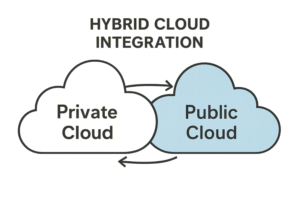
Hybrid cloud computing is a strategic approach that combines on-premises infrastructure (private cloud) with public cloud services. This model allows businesses to keep sensitive data and critical applications in a secure, private environment while leveraging the scalability and cost-effectiveness of public cloud resources for less sensitive operations.
Benefits of Hybrid Cloud Solutions
Enhanced Flexibility and Scalability
Hybrid cloud solutions enable businesses to scale resources up or down according to demand, providing them with the agility to adapt. This flexibility allows companies to manage varying workloads efficiently, thereby avoiding both over-provisioning and underutilization of resources.
Improved Security and Compliance
By maintaining sensitive data on-premises and utilizing public cloud services for other operations, organizations can better adhere to regulatory requirements and enhance data security. This approach minimizes the risk of data breaches and ensures compliance with industry standards.
Cost Efficiency
Hybrid cloud models enable businesses to optimize costs by balancing the use of private and public cloud resources, thereby reducing overall expenses. Companies can reduce capital expenditures on infrastructure by leveraging public cloud services for non-critical workloads, paying only for what they use.
Business Continuity and Disaster Recovery
Distributing workloads across private and public clouds enhances business continuity and resilience. In the event of a failure in one environment, operations can seamlessly transition to the other, minimizing downtime and ensuring continuous service delivery.
Facilitating Innovation
Hybrid cloud environments support the rapid development and deployment of new applications and services. Businesses can experiment with new technologies in the public cloud without disrupting their existing private cloud operations, thereby fostering innovation and a competitive advantage.
Implementing Hybrid Cloud in Your Business
To successfully implement a hybrid cloud strategy, businesses should:
- Assess current IT infrastructure and identify workloads suitable for migration to the cloud.
- Choose reliable cloud service providers that align with business objectives and compliance requirements.
- Develop a comprehensive migration plan that includes data transfer, application integration, and security measures.
- Establish robust monitoring and management practices to effectively oversee hybrid cloud operations.
Challenges and Considerations
While hybrid cloud solutions offer numerous benefits, businesses must address challenges such as:
- Ensuring seamless integration between private and public cloud environments.
- Managing complex security protocols across different platforms.
- Monitoring and controlling costs associated with cloud services.
- Maintaining compliance with industry regulations and standards.
Case Studies of Successful Hybrid Cloud Adoption
Many organizations are increasingly adopting hybrid cloud solutions to achieve their strategic business objectives and enhance operational efficiency. A recent report noted that numerous U.S. public sector agencies are leveraging hybrid cloud managed services to phase out aging legacy systems, addressing challenges such as limited budgets and staffing shortages. By integrating on-premises infrastructure with cloud resources, these agencies can modernize their IT environments, enhance scalability, and maintain regulatory compliance, all while controlling costs. This flexible approach allows organizations to optimize performance, reduce operational complexity, and achieve modernization goals without exceeding financial or resource constraints.
Future Trends in Hybrid Cloud
The hybrid cloud landscape is continually evolving. Future trends include:
- Increased adoption of AI and machine learning to optimize cloud operations and enhance decision-making processes.
- Greater emphasis on sustainability, with cloud providers implementing green initiatives to reduce carbon footprints.
- Enhanced security measures, including zero-trust architectures and advanced threat detection systems.
- Expansion of edge computing capabilities to process data closer to the source, reducing latency and improving performance.
Conclusion
Hybrid cloud solutions provide modern organizations with a flexible and strategic approach to managing IT infrastructure, combining the control and security of private clouds with the scalability and cost efficiency of public clouds. This balanced model allows businesses to place sensitive workloads in secure environments while leveraging public resources for growth and innovation. With careful planning, strong governance, and effective integration, companies can overcome potential challenges, including those related to data management and compliance. When implemented thoughtfully, hybrid cloud environments enhance agility, streamline operations, facilitate digital transformation, and enable organizations to remain competitive in an increasingly fast-paced digital landscape.

Building A Better Commercial Painting Plan From Prep To Completion

What Makes Legal Marketing Different From Marketing Almost Anything Else?

Why Bar Stools Can Completely Change the Feel of a Kitchen
Ways Proper Garage Door Installation Improves Performance

How to Compare Maine Neighborhoods Before Buying a Home in 2026

The Future of Home EV Charging: Trends, Benefits, and What Drivers Need to Know

How Septic Tank Pumping Services in Huntsville AL Protect Soil Absorption Systems

Foundation Crack Repair Using Injection Methods

How do you know when you need to change your primary care doctor
The Importance of Accurate Inventories Before Moving Day
Ways Proper Garage Door Installation Improves Performance
What Makes Legal Marketing Different From Marketing Almost Anything Else?
Why Bar Stools Can Completely Change the Feel of a Kitchen