
Truck Accident Law
What the Black Box in a Truck Really Shows

Key Takeaways
- Truck black boxes (Event Data Recorders) provide crucial data after an accident, including speed, brake usage, and real-time vehicle movements.
- This data serves as an objective source for reconstructing accidents and supports or challenges witness accounts and driver statements.
- Legal protocols and privacy laws closely govern who can access black box data and how it is handled.
- Interpreting data requires specialized expertise and often plays a critical role in legal proceedings in truck accident cases.
Table of Contents
- Understanding the Truck’s Black Box
- Key Data Captured by Black Boxes
- The Role of Black Box Data in Accident Investigations
- Legal Implications and Access to Black Box Data
- Privacy Concerns and Regulations
- Challenges in Interpreting Black Box Data
- Conclusion
Understanding the Truck’s Black Box
Truck accidents can result in life-changing consequences, and reconstructing these events is rarely straightforward. Understanding what happened in the crucial moments before and during a crash often relies on one key piece of technology: the black box, or Event Data Recorder (EDR). Modern trucks are fitted with EDRs that quietly track a range of vehicle and driver inputs. These devices have become an indispensable tool, not only for accident investigators but also for attorneys and insurance companies seeking the facts.
If you or someone you love has been involved in a truck accident, understanding what the truck’s black box records can do to impact your case dramatically is essential. The evidence captured can be the difference between winning and losing compensation. To learn how to secure and use this vital data, consult with RSH Legal, a firm experienced in handling truck accident claims and EDR evidence.
Key Data Captured by Black Boxes
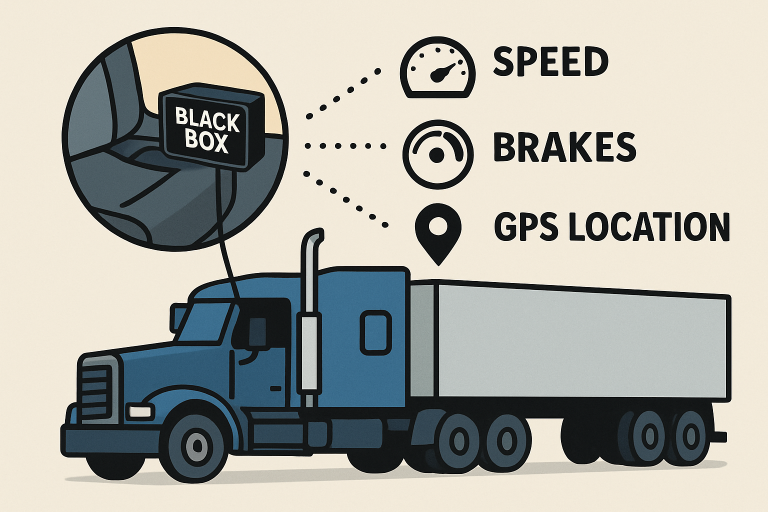
At their core, black boxes are data loggers designed to help reconstruct the circumstances of a collision. They automatically record a myriad of details about the truck’s performance. Here is what you can typically expect a truck black box to document:
- Speed: The recorder notes the truck’s speed for several seconds before and during the collision.
- Brake Application: When and how aggressively the brakes were used, which helps determine if evasive action was attempted.
- Throttle Position: Information about whether the accelerator was engaged or released.
- Seatbelt Usage: Whether or not the driver wore a seatbelt at the time of impact.
- Engine RPMs: Engine revolutions per minute, helping track shifts in speed and power output.
- Steering Inputs: Direction and movement of the steering wheel, which can highlight avoidance maneuvers or lack thereof.
- GPS Data: Information about the truck’s precise location and travel path before the accident.
Collectively, these metrics offer an unparalleled view of the truck’s and driver’s actions, filling in gaps that traditional accident reports or eyewitness testimony can leave behind. This information is often cited in research and legal analysis, as covered in resources such as NHTSA’s event data recorder overview.
The Role of Black Box Data in Accident Investigations
Black box data is often the objective voice in accident investigations. This data can confirm or refute statements made by drivers, trucking companies, or witnesses. For example, if a driver maintains they were driving within the speed limit, the black box either validates or contradicts that claim based on the recorded speed at the time of the incident. Law enforcement agencies and insurers increasingly rely on this unbiased evidence to piece together the chain of events and establish liability.
In more complex cases, black-box data may complement or clarify video footage, skid mark analysis, and physical vehicle inspections. This holistic approach, explained by sources such as The New York Times, is transforming how accident investigations are conducted.
Legal Implications and Access to Black Box Data
Legal considerations significantly affect access to black box data. In most cases, the data is owned by the trucking company. If you are a victim or legal representative seeking this information, you may need to obtain a court order or file a legal motion to preserve and release the black box information. Time is critical in these instances, as black box data can sometimes be overwritten by the truck’s system or lost if the vehicle is repaired or returned to service.
Attorneys often intervene quickly and send a “spoliation letter” to the trucking company, formally requesting the preservation of any data relevant to a claim or lawsuit. Without these steps, crucial evidence could be lost, diminishing a victim’s ability to prove fault or recover damages.
Privacy Concerns and Regulations
While EDRs offer essential details, they also bring privacy concerns, particularly about who can access the data and how it may be used. In the United States, the Driver Privacy Act of 2015 clarifies that the information belongs to the vehicle’s owner or lessee and that access is generally restricted unless the owner consents or a court orders its release. This legal framework aims to balance the need for factual accident reconstruction against personal privacy, a topic explored by legal reviews and government watchdogs.
This regulatory environment ensures strong privacy protections, but it also means those involved in a truck accident should not assume automatic access to EDR information. It reinforces the importance of quick legal action to protect and obtain key evidence.
Challenges in Interpreting Black Box Data
Extracting and making sense of black box data requires specialized expertise and, occasionally, proprietary equipment. The raw output of EDRs is typically unreadable to the untrained eye, making expert analysis essential for anyone using this evidence in legal or insurance contexts. Judges and juries must be presented with clear, understandable interpretations, so the information’s reliability and admissibility in court often hinge on the credentials and skill of the analyst.
This step is so integral that mishandling the data or misinterpreting results can compromise an entire case. Accident reconstructionists, engineers, and other specialists play a vital role in turning digital records into actionable insights that withstand legal scrutiny.
Conclusion
The black box in a truck is much more than a passive recorder. It stands at the center of accident investigation, legal claims, and efforts to improve safety on the nation’s roadways. Its objective perspective can illuminate the factors that led to crashes, supporting justice for victims and safeguarding drivers’ rights. Ensuring this information is secured and interpreted correctly often requires professional legal and technical assistance, so acting promptly after an accident is critical to safeguarding your interests.

Building A Better Commercial Painting Plan From Prep To Completion

What Makes Legal Marketing Different From Marketing Almost Anything Else?

Why Bar Stools Can Completely Change the Feel of a Kitchen
Ways Proper Garage Door Installation Improves Performance

How to Compare Maine Neighborhoods Before Buying a Home in 2026

The Future of Home EV Charging: Trends, Benefits, and What Drivers Need to Know

How Septic Tank Pumping Services in Huntsville AL Protect Soil Absorption Systems

Foundation Crack Repair Using Injection Methods

How do you know when you need to change your primary care doctor
The Importance of Accurate Inventories Before Moving Day
Ways Proper Garage Door Installation Improves Performance
What Makes Legal Marketing Different From Marketing Almost Anything Else?
Why Bar Stools Can Completely Change the Feel of a Kitchen