
Health
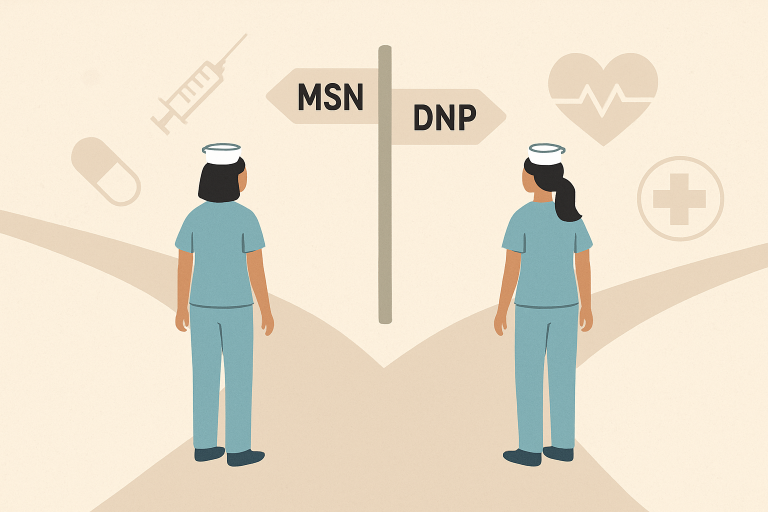
What Is a DNP and How Does It Differ from an MSN?

Key Takeaways:
- MSN focuses on advanced clinical roles, while DNP focuses on leadership, policy, and system-level impact.
- MSN leads to nurse practitioner, educator, or administrator roles; DNP prepares for executive, policy, and faculty positions.
- Both offer strong earning potential, with DNP often leading to higher-paying leadership roles.
- MSN typically takes about 2 years; DNP takes 3–4 years and offers broader career opportunities.
- DNP is becoming the preferred standard for advanced nursing leadership roles.
Introduction to Advanced Nursing Degrees
For registered nurses looking to advance their careers in a rapidly evolving healthcare landscape, graduate-level nursing degrees such as the Master of Science in Nursing (MSN) and the Doctor of Nursing Practice (DNP) are at the forefront of opportunity. These advanced qualifications open new doors for specialized roles and empower nurses to influence healthcare outcomes at both the patient and system levels. Nurses considering an advanced degree might explore DNP in Nurse Education online programs as a flexible way to reach higher clinical and educational expertise levels.
The increase in complex patient needs and the drive for evidence-based care have made these graduate programs more critical than ever before. While the MSN and DNP prepare nurses for enhanced practice, leadership, and education roles, they diverge in scope, depth, and career trajectory.
Defining the MSN and DNP Degrees
The MSN is a widely recognized graduate degree tailored for registered nurses aiming to take on specialized positions in clinical practice, administration, or academia. Arkansas State University emphasizes that this degree provides a strong foundation in advanced clinical skills, critical thinking, and theoretical frameworks pivotal to patient care, typically completed in two years of full-time study.
By contrast, the DNP is a terminal professional degree emphasizing clinical leadership. Rooted in an MSN foundation, DNP programs require additional focus on healthcare policy, systems leadership, evidence-based practice, and quality improvement. Completing a DNP often takes three to four years of full-time enrollment, emphasizing advanced knowledge and the ability to translate research into impactful clinical outcomes.
Curriculum and Clinical Training
MSN and DNP programs include rigorous advanced health assessment, pathophysiology, and pharmacology coursework. However, the DNP curriculum is more extensive, incorporating training in healthcare technology, organizational leadership, population health, and systems analysis. A defining feature of the DNP is the scholarly project, where students lead initiatives to improve healthcare delivery—applying research directly to practice settings and often publishing or presenting their outcomes.
Career Opportunities and Roles
Graduates of MSN programs are well-positioned for roles such as nurse practitioner (NP), clinical nurse specialist, nurse anesthetist, nurse educator, and nurse administrator. These roles often emphasize direct patient care and education, with specialty certifications ranging from family practice to mental health or critical care.
While qualified for the same advanced clinical roles as their MSN counterparts, DNP-prepared nurses are uniquely trained to take on high-impact responsibilities. These include clinical leadership, executive management, designing and evaluating health policy, and faculty positions at leading academic institutions. DNP graduates are increasingly at the forefront of leading patient care initiatives, advancing interdisciplinary collaboration, and addressing key healthcare challenges at organizational and policy levels.
Salary and Job Outlook
Nursing is consistently ranked among the most in-demand and well-compensated professions. According to the U.S. Bureau of Labor Statistics, the median annual wage for nurse practitioners was $117,670 as of 2020, and overall employment in advanced practice nursing is projected to grow much faster than average for all occupations through the decade. While both MSN and DNP graduates can expect strong earning potential, those with a DNP often rise to higher-salaried positions due to their leadership and systems-focused training.
Time and Financial Investment
Investing in a DNP requires more time and financial resources than pursuing an MSN. A full-time DNP pathway may take up to four years, while an MSN generally takes two. Tuition, clinical requirements, and other educational expenses should be considered against the potential for greater long-term earnings and expanded career flexibility.
Future Trends in Nursing Education
Professional organizations like the American Association of Colleges of Nursing advocate for the DNP to become the new benchmark for entry into advanced practice nursing roles. This push is spurred by the growing demands for advanced clinical judgment, leadership in quality improvement, and the navigation of rapidly transforming healthcare systems. Projections suggest that more employers prioritize DNP-prepared nurses in leadership and policy-shaping roles, making advanced education increasingly relevant for new and practicing nurses.
Final Thoughts
Deciding between an MSN and a DNP is a deeply personal and professional choice. The MSN offers a proven pathway to advanced clinical practice and specialty certification, ideal for nurses primarily interested in direct patient care. While requiring greater investment, the DNP expands professional horizons, equipping nurses to transform healthcare systems, educate future generations, and impact health policy at large.
Ultimately, both degrees empower nurses to deliver high-quality care and respond to the evolving needs of patients and communities. Those seeking broader scope and deeper influence within healthcare should carefully weigh their goals, resources, and the profound opportunities advanced nursing education provides.
Ways Proper Garage Door Installation Improves Performance

How to Compare Maine Neighborhoods Before Buying a Home in 2026

The Future of Home EV Charging: Trends, Benefits, and What Drivers Need to Know

How Septic Tank Pumping Services in Huntsville AL Protect Soil Absorption Systems

Foundation Crack Repair Using Injection Methods

How do you know when you need to change your primary care doctor
The Importance of Accurate Inventories Before Moving Day

Miami Beach Real Estate Trends and Insights for Homebuyers and Sellers

Supporting Aging Loved Ones in Winston-Salem: A Family Guide to Senior Care

The Evolution of Youth Basketball Tournaments: Trends, Technology, and Community Impact
Foundation Crack Repair Using Injection Methods
The Future of Home EV Charging: Trends, Benefits, and What Drivers Need to Know
How Septic Tank Pumping Services in Huntsville AL Protect Soil Absorption Systems