
Home Improvement
Innovative Approaches to Temporary Cooling Solutions

Key Takeaways
- Exploring cutting-edge technologies for efficient temporary cooling.
- Understanding the benefits of sustainable and energy-efficient cooling methods.
- Recognizing the importance of adaptable cooling solutions in various industries.
Table of Contents
- Ice Batteries for Sustainable Cooling
- Advanced Chip Cooling Techniques
- Hydrogel Evaporative Cooling
- Radiative Cooling Materials
- Ventilative Cooling Strategies
- Portable HVAC Systems
- Hybrid Cooling Solutions
- Sustainable Cooling Innovations
Meeting the demands of modern industry and adapting to global temperature fluctuations requires constant innovation in cooling technology. From energy-efficient storage solutions to resilient, portable systems, organizations have more options than ever to maintain comfortable climates, protect sensitive equipment, and ensure business continuity. With advancements in sustainability and adaptability, Temporary Cooling Solutions stand at the forefront of this rapidly evolving sector, serving a variety of industries that need flexible, rapid climate control.
These evolving methods not only help reduce energy consumption but also offer viable strategies for navigating extreme heat events, improving worksite productivity, and complementing permanent infrastructure. By leveraging adaptable and efficient cooling innovations, organizations can address everything from planned expansions to unexpected emergencies. Strategic cooling can make the difference between operational success and costly downtime.
While planned installations are common, businesses may also need immediate relief during breakdowns or in crisis conditions. For those instances, solutions like Emergency HVAC can provide rapid response and minimize disruptions.
Ice Batteries for Sustainable Cooling
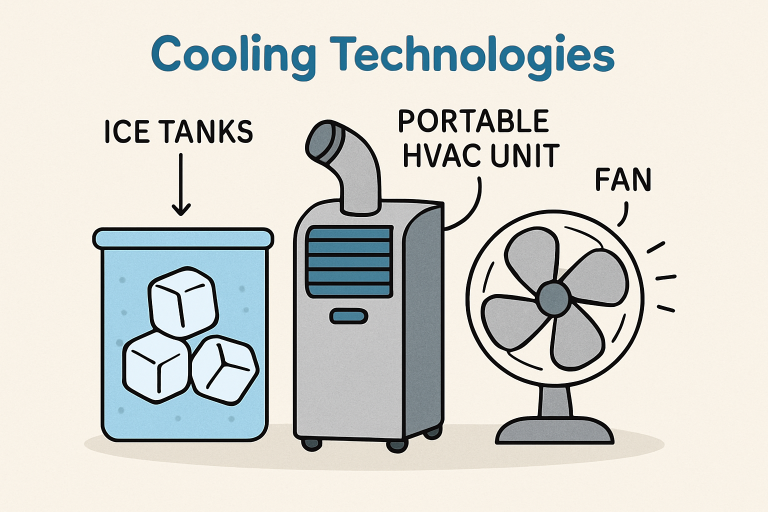
Ice thermal energy storage, commonly known as “ice batteries,” is an efficient and environmentally friendly solution for large-scale air conditioning. During off-peak nighttime hours, massive tanks freeze water, then use this stored ice to cool air during peak daytime demand. Not only does this drastically decrease strain on the electric grid, but it also significantly cuts operational costs and carbon emissions. Facilities like hospitals, universities, and commercial buildings benefit from this approach, supported by major providers such as Trane Technologies and Nostromo Energy. By decoupling energy usage from time-of-day price fluctuations, ice batteries create both economic and environmental advantages.
Advanced Chip Cooling Techniques
In sectors reliant on complex electronics, such as data centers and high-performance computing, new chip cooling methods are critical to maintaining operational stability. A recent breakthrough from the University of Tokyo employs microfluidic cooling, where water’s phase change from liquid to gas enables rapid heat removal directly from the chip’s surface. This three-dimensional network of capillaries and manifolds is embedded within the chip, carefully engineered to prevent steam blockages. With a dramatic increase in coefficient of performance compared to traditional solutions and the ability to dynamically adapt to thermal loads, this technique sets a benchmark for future electronic cooling systems.
Hydrogel Evaporative Cooling
As extreme heat increasingly threatens health and productivity, personal cooling innovations are increasingly turning to hydrogel evaporative systems. Hydrogels absorb and retain water, releasing cooling vapor as temperatures rise. However, their efficiency is challenged by persistently hot and humid conditions. By integrating thermoelectric devices with hydrogels, researchers have produced hybrid products that draw heat away from the skin while simultaneously increasing vaporization rates, enhancing comfort even in oppressive heat. The adaptability of these lightweight devices makes them suitable for outdoor workers, emergency responders, and vulnerable populations during heatwaves.
Radiative Cooling Materials
Modern radiative cooling materials harness thermal radiation to passively lower surface temperatures below ambient levels, using no external power. Historically limited by their reflective, monochrome surfaces, today’s colored daytime radiative coolers (CDRCs) achieve both effective cooling and aesthetic value. Recent advancements in polymer-Tamm photonic structures offer customizable color finishes without compromising heat-rejection performance. These coatings can be scaled using commercial roll-to-roll techniques, opening pathways for their use in architectural design, automotive applications, and beyond.
Ventilative Cooling Strategies
Ventilative cooling is an age-old concept supercharged by contemporary engineering and data-driven controls. By optimizing airflow through automated louvers, operable windows, and mechanical systems, buildings harness outdoor air to displace heat with minimal energy input. Initiatives like Venticool, an international platform dedicated to promoting and researching ventilative cooling, provide key resources to guide designers and facility managers. Resilient ventilative cooling ensures that critical infrastructure withstands not only regular weather extremes but also disruptions like power failures or unforeseen occupancy changes.
Portable HVAC Systems
Flexibility is increasingly valued in industrial settings, data centers, and event venues. Portable HVAC units allow organizations to deliver precise cooling exactly where it is needed, helping manage temporary spikes in demand or providing climate control during repairs and upgrades. By targeting specific zones and supplementing existing central HVAC systems, these units reduce energy waste and extend equipment life. The ability to rapidly deploy portable cooling makes them indispensable for short-term projects, maintenance windows, and emergency responses.
Hybrid Cooling Solutions
Hybrid cooling solutions blend multiple methods to achieve maximum effectiveness and energy savings. In outdoor environments, systems often combine misting nozzles and high-powered fans with solar panels and weather sensors. Smart controllers automate response to shifting conditions, using zoned activation and scheduled run times to optimize cooling output while minimizing electricity consumption. Integrating such technology ensures not just comfort, but a marked reduction in resource use, making hybrid approaches particularly suitable for large venues, festivals, and public spaces.
Sustainable Cooling Innovations
The next frontier in sustainable cooling focuses on energy and water use at scale. For instance, the Baltimore Aircoil Company has developed immersion-cooling tanks designed for data centers, which traditionally consume immense energy for temperature management. Their solution involves submerging servers in non-conductive fluids to dissipate heat, cutting energy consumption by over half compared to air-based systems. Such advances provide a roadmap for facility managers aiming to balance productivity, resource conservation, and operational continuity in critical environments, particularly as digital infrastructure expands.

Building A Better Commercial Painting Plan From Prep To Completion

What Makes Legal Marketing Different From Marketing Almost Anything Else?

Why Bar Stools Can Completely Change the Feel of a Kitchen
Ways Proper Garage Door Installation Improves Performance

How to Compare Maine Neighborhoods Before Buying a Home in 2026

The Future of Home EV Charging: Trends, Benefits, and What Drivers Need to Know

How Septic Tank Pumping Services in Huntsville AL Protect Soil Absorption Systems

Foundation Crack Repair Using Injection Methods

How do you know when you need to change your primary care doctor
The Importance of Accurate Inventories Before Moving Day
Ways Proper Garage Door Installation Improves Performance
What Makes Legal Marketing Different From Marketing Almost Anything Else?
Why Bar Stools Can Completely Change the Feel of a Kitchen