
Technology
Designing Durable Concrete Parking Lots for Heavy Vehicles

Concrete is a proven solution for heavy-duty parking lots, offering durability, structural integrity, and cost-effectiveness. It resists rutting and maintains a stable surface under immense loads. Concrete’s lighter color enhances visibility and nighttime safety and reduces lighting expenses. Planning and execution must consider environmental, usage, and maintenance needs to create parking lots that stand the test of time. Integrating proven design and construction principles optimizes function and value for facilities requiring reliable performance for heavy vehicles.
Benefits of Concrete for Heavy Vehicle Parking
Concrete is a cost-effective and efficient choice for parking lots, transit buses, and industrial facilities due to its high compressive strength, which prevents rutting and cracking, reducing repair costs and vehicle downtime. Its reflectivity also lowers energy costs and improves driver visibility, enhancing safety. Concrete is also more resistant to damage from petroleum-based fluids, reducing the need for spot repairs and ensuring the integrity of asphalt surfaces.
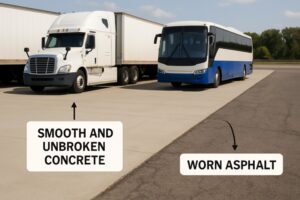
Essential Design Considerations
Consider current and future operational demands to design a successful heavy-duty parking lot. This includes load-bearing capacity, traffic patterns, and environmental conditions. Design sections to manage maximum axle loads without collapse or fatigue, varying pavement thickness to match vehicle weights. Analyze heavy traffic areas, frequent turning zones, loading dock approaches, and high-impact sections for extra reinforcement. Adapt concrete selection and mix design to local climate challenges, ensuring a safe and efficient parking lot.
Subgrade Preparation and Drainage
Concrete parking lot stability relies on the subgrade’s condition and engineering. Uniform compaction of soil prevents uneven settling, preventing cracks and structural failures. Thorough soil evaluation and amendment with gravel or stabilization materials are essential. Effective drainage planning, including a minimal slope of at least 0.4%, channels rainfall away from the slab, preventing standing water damage. Permeable surfaces and subsurface drains can also reduce maintenance and repair costs.
Concrete Mix and Thickness
For heavy vehicle applications, the compressive strength of the chosen concrete mix is crucial. Most experts recommend a mix with a compressive strength between 4,000 and 5,000 psi, but project-specific requirements may dictate higher strengths. The pavement’s thickness is equally important: for areas with regular truck or commercial bus activity, a minimum thickness of 6 inches is typical, while access roads or loading docks may require 8 inches or more. Proper placement, curing, and inspection ensure the mix achieves its intended strength and durability.
Jointing and Reinforcement
Concrete expands and contracts with temperature and moisture changes, so jointing is crucial to control cracks. Joints should be spaced 12-15 feet apart and aligned with traffic direction for maximum strength. Reinforcement through steel rebar or fiber mesh adds resilience in high-stress areas, distributing loads and preventing crack propagation. These systems are especially useful in entryways, loading zones, or equipment pivoting areas.
Maintenance Practices
Regular maintenance of concrete parking lots extends their lifespan by promptly removing debris and harmful chemicals, addressing minor cracks, and applying concrete sealers to enhance resistance to stains, moisture, and UV rays. Regular inspections from pavement professionals ensure early detection of subsurface issues, settlement, or drainage failures, thereby preventing surface deterioration and extending the slab’s integrity.

How to Plan a Safer, Longer-Lasting Industrial Metal Fabrication Project in Lufkin, Texas

How to Keep Phoenix, Arizona Homes Pest-Ready During Monsoon Season
Floating Dock Contractors and the Basics of a Stable Dock System

How to Judge a Mountain Home Before You Buy in Aspen, Colorado

Building A Better Commercial Painting Plan From Prep To Completion

What Makes Legal Marketing Different From Marketing Almost Anything Else?

Why Bar Stools Can Completely Change the Feel of a Kitchen
Ways Proper Garage Door Installation Improves Performance

How to Compare Maine Neighborhoods Before Buying a Home in 2026

The Future of Home EV Charging: Trends, Benefits, and What Drivers Need to Know
Building A Better Commercial Painting Plan From Prep To Completion
How to Judge a Mountain Home Before You Buy in Aspen, Colorado
Floating Dock Contractors and the Basics of a Stable Dock System
How to Keep Phoenix, Arizona Homes Pest-Ready During Monsoon Season