
Real Estate
Construction Technologies Shaping Modern Commercial Spaces

Table of Contents
- Smart Buildings and IoT Integration
- Modular and Prefabricated Construction
- Sustainable Building Practices
- Building Information Modeling (BIM)
- 3D Printing and Robotics
- Adaptive Reuse and Flexible Design
- Augmented Reality (AR) and Virtual Reality (VR)
- Conclusion
The commercial construction industry is undergoing a remarkable transformation, propelled by a wave of innovative technologies that are fundamentally changing the way buildings are planned, constructed, and managed. From dramatic efficiency gains to solutions that emphasize sustainability and adaptability, developers and building owners are seeking every advantage to create smarter, more resilient commercial environments. These technology-driven advances help maximize financial performance, minimize environmental impact, and create dynamic, user-friendly spaces. At the forefront of this revolution, businesses and property owners are increasingly partnering with experienced professionals from industry leaders such as those at https://koehncs.com to unlock the potential of innovative methods and stay ahead in the marketplace. By leveraging these advancements from the early design phase onward, organizations can craft commercial spaces that deliver long-lasting value and operational excellence.
Several breakthrough technologies especially those involving the Internet of Things (IoT), modular construction strategies, and both augmented and virtual reality applications have transitioned from conceptual innovations to practical, everyday construction tools. Together, these advancements are driving real transformation across modern commercial landscapes. With their ability to fine-tune resource management, enhance building performance, and improve occupant experience, they are vital in balancing operational needs, environmental stewardship, and long-term profitability. The sections below explore how each of these technologies, which not long ago seemed futuristic, are shaping the future of commercial real estate by creating environments that are not only visually stunning but also highly functional and efficient.
Smart Buildings and IoT Integration
Modern commercial buildings are evolving into complex digital ecosystems, where interconnected sensors and smart devices seamlessly communicate to respond to building needs with accuracy and efficiency. Through robust Internet of Things (IoT) integration, building management systems can now automate essential functions such as lighting, heating, ventilation, and air conditioning (HVAC), and security by dynamically adjusting settings in response to real-time occupancy, environmental conditions, and even weather forecasts. These intelligent networks offer not only significant energy savings but also ensure spaces are optimized for comfort, safety, and productivity. For instance, AI-powered systems can track usage patterns to dim lights or adjust ventilation, reducing unnecessary energy expenditures when an area is unoccupied. High-profile projects like The Edge in Amsterdam have set a global standard, leveraging a network of thousands of IoT sensors and advanced AI algorithms to minimize operational costs and carbon emissions while enhancing workspace quality. As detailed in a recent Forbes article, the rapid adoption of smart building technologies reflects a broader shift toward data-driven management within the commercial sector enabling organizations to track performance, predict maintenance needs, and respond to issues with unprecedented speed and precision. This level of automation drives both competitive advantage and long-term cost savings for building owners and users alike.
Modular and Prefabricated Construction
Modular construction, where structures are built in standardized, prefabricated sections off-site and later assembled on-site, has emerged as a revolutionary approach that delivers projects faster and more efficiently. This technique fundamentally transforms the typical construction process by reducing weather-related delays and limiting on-site disruptions, making it ideal for campuses, hospitals, hotels, and developments in densely populated city settings. Prefabrication also improves quality control, as elements are manufactured in controlled environments before transportation, minimizing errors and allowing strict adherence to design specifications. Material waste and environmental impact are also significantly reduced because modules are fabricated to precise measurements, allowing unused materials to be recycled more easily. The speed at which modular construction enables buildings to be completed is particularly valuable in sectors that require quick solutions, such as healthcare expansions in response to sudden demand or educational facilities needed to accommodate growing student populations. Not only does this process shorten project timelines, but it also ensures minimal interference with ongoing operations in the surrounding environment. With increasing urbanization, modular and prefabricated construction techniques are proving essential for addressing both time and sustainability challenges in today’s commercial projects.
Sustainable Building Practices
Today’s commercial construction projects are placing sustainability front and center, as environmental consciousness and corporate responsibility become core business values. Builders and investors alike are prioritizing eco-friendly building materials, including recycled steel, sustainably sourced timber, and low-VOC (volatile organic compound) finishes that improve indoor air quality. Additionally, integrating renewable energy sources, such as solar panels, geothermal systems, and green roofs, not only reduces ongoing energy costs but can also contribute to a project’s eligibility for industry-recognized certifications, such as LEED or WELL. These certifications, once simply a bonus, have now become vital selling points, enhancing a property’s desirability and often its financial performance. The Bullitt Center in Seattle serves as a brilliant example of what’s possible, combining net-zero energy design, rainwater capture systems, and composting toilets to demonstrate how commercial spaces can operate sustainably while remaining economically viable over time. Besides tangible cost reductions in utilities, sustainable buildings are associated with increased occupant well-being, improved productivity, and stronger market reputations, which are critical considerations for businesses competing to attract and retain top talent. Ultimately, sustainable building practices not only help mitigate climate risks but also align with evolving stakeholder expectations and regulatory requirements.
Building Information Modeling (BIM)
The digital revolution in construction is epitomized by Building Information Modeling (BIM), a collaborative process that generates comprehensive, three-dimensional representations of buildings before any physical work begins. With BIM platforms, architects, engineers, contractors, and owners work together in a shared digital environment, enabling everyone to spot and resolve design clashes, coordinate systems, and optimize construction sequences long before materials reach the site. This not only drastically reduces costly field changes and waste but also facilitates more accurate budgeting and scheduling. Today’s advanced BIM solutions even go beyond 3D visualization, offering 5D BIM that integrates real-time cost estimation and project timelines into models for holistic project management. This heightened transparency ensures informed decision-making, keeps stakeholders aligned throughout the construction process, and helps projects stay on schedule and under budget. As highlighted by Architectural Digest, BIM’s rise is propelling the architecture, engineering, and construction (AEC) industries toward faster, safer, and more sustainable outcomes, reshaping how commercial spaces are brought to life from concept to completion.
3D Printing and Robotics
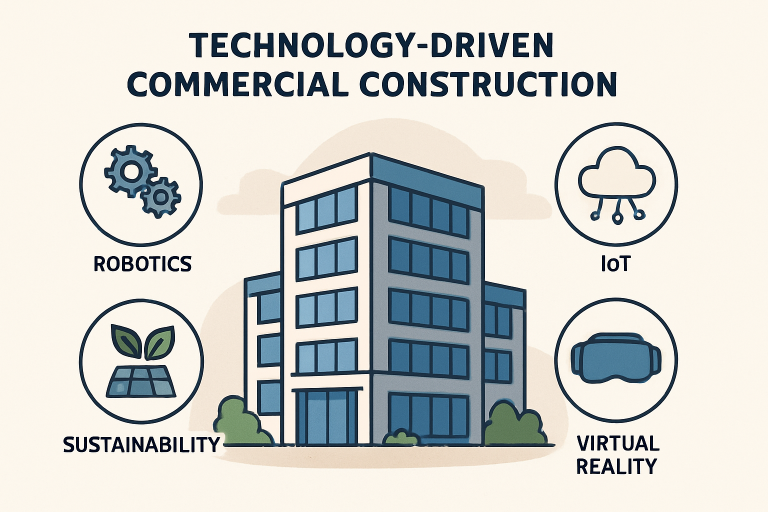
The adoption of 3D printing and robotics is unlocking efficiencies and creative opportunities previously unattainable in commercial construction. Large-scale 3D printers can now fabricate structural and decorative building elements with a level of customization and complexity that was once cost-prohibitive, enabling architects to push the boundaries of design while maintaining pragmatic budget controls. These printers deposit materials precisely where needed, reducing waste associated with traditional subtractive manufacturing methods. Simultaneously, the use of construction robots on job sites—capable of tasks like laying bricks, pouring concrete, and performing repetitive finishing work—is improving jobsite safety and consistency. Robotics can also access confined or hazardous environments, reducing risks to human workers and speeding up critical project phases. By automating tedious or risky activities, these technologies free up skilled professionals to focus on more specialized tasks and project management, enhancing on-site productivity and innovation. This convergence of 3D printing and robotics is helping commercial builders meet escalating demands for speed, quality, and adaptability in a resource-constrained world.
Adaptive Reuse and Flexible Design
Adaptive reuse is redefining how we think about commercial real estate, transforming outdated warehouses, factories, and historic buildings into thriving offices, retail centers, or mixed-use hubs. This approach not only preserves the unique elements of architectural heritage and neighborhood character but also drastically reduces the environmental toll of demolition and new construction. By repurposing existing structures, developers can minimize landfill waste, conserve resources, and often enjoy expedited permitting processes or tax incentives. In parallel, the adoption of flexible design principles is helping businesses futureproof their spaces. Moveable partitions, modular furnishings, and adaptable building systems enable organizations to quickly and efficiently reconfigure layouts in response to changing workforce dynamics or operational needs. For example, growing companies can expand workspaces or create new collaboration zones without costly renovations. At the same time, building owners can attract a wider variety of tenants by offering spaces that suit multiple uses. In a rapidly evolving market, adaptive reuse and flexible design are crucial strategies for maximizing property value, minimizing environmental impact, and supporting the changing requirements of modern commerce.
Augmented Reality (AR) and Virtual Reality (VR)
The utilization of Augmented Reality (AR) and Virtual Reality (VR) in commercial construction projects is radically improving how stakeholders design, collaborate, and make decisions. With AR and VR technologies, architects and clients can virtually walk through proposed spaces, inspecting layouts, textures, and even lighting conditions as if the buildings already existed. This immersive experience allows for immediate feedback and revision requests, dramatically reducing the risk of costly misunderstandings or dissatisfaction later in the construction process. Developers can ensure that stakeholder expectations are aligned early on, streamlining approvals and reducing project timelines. VR and AR are also invaluable during construction, giving workers interactive installation guidance or helping maintenance teams visualize hidden mechanical or electrical systems behind finished walls. By making information more accessible and actionable, these technologies eliminate guesswork and rework, ultimately conserving resources and enhancing project delivery for everyone involved.
Conclusion
A broad range of technological innovations is fundamentally reimagining the commercial construction sector. From the integration of smart building systems and IoT to the rise of modular construction, BIM collaboration, and immersive visualization tools, today’s advancements are creating smarter, more resilient spaces while supporting environmental and economic goals. In an industry often defined by tight margins and rising expectations, these technologies aren’t just trends—they’re critical components of a strategy that embraces efficiency, sustainability, and adaptability as paths to success. As we look ahead, businesses that harness these tools in partnership with experienced construction professionals will be best positioned to thrive in a complex and rapidly changing world.

Building A Better Commercial Painting Plan From Prep To Completion

What Makes Legal Marketing Different From Marketing Almost Anything Else?

Why Bar Stools Can Completely Change the Feel of a Kitchen
Ways Proper Garage Door Installation Improves Performance

How to Compare Maine Neighborhoods Before Buying a Home in 2026

The Future of Home EV Charging: Trends, Benefits, and What Drivers Need to Know

How Septic Tank Pumping Services in Huntsville AL Protect Soil Absorption Systems

Foundation Crack Repair Using Injection Methods

How do you know when you need to change your primary care doctor
The Importance of Accurate Inventories Before Moving Day
Ways Proper Garage Door Installation Improves Performance
What Makes Legal Marketing Different From Marketing Almost Anything Else?
Why Bar Stools Can Completely Change the Feel of a Kitchen